Martha Marcy May Marlene // Cold comfort cult

martha marcy may marlene film poster design with elizabeth olsen


The film's ending is a stroke of genius. Not because of its ambiguous nature but because for the first time in so long, a filmmaker finally knew when to stop. Many films that have come out in recent years begin to ruin itself because it keeps on running long after its legs start to wear out. Sean Durkin's debut feature film Martha Marcy May Marlene has perfect pacing. It unravels in such a slow, ponderous way that gives enough time for its audience to think about what they have just seen while never extending a scene's running time long enough to invite boredom. When the film finally ends, it is unanticipated but doesn't feel abrupt. This is the kind of story that will feel less powerful and make less of an impact if given a conclusion. Sometimes you just have to deny satisfaction to give satisfaction. If you haven't seen this, you'll know what I mean when you see the ending.

Martha, played by the exciting new talent Elizabeth Olsen (yes, the sister of those twins) escapes what seems to be a cult in the Catskill. She is picked up by her sister, Lucy, and taken back to her lake house she shares with her husband in Connecticut. Both sisters have not seen each other for a while, but there are noticeable tensions and differences between them. Scenes in the lake house are intercut with various experiences Martha had in the cult, including a very heavy scene involving a shooting practice and baby kittens.

This intercutting is one of the film’s great strengths and it’s a smart directorial decision because it lets us compare the two time periods of Martha’s life. Ultimately at the end however, we find that the scenes in the cult and the scenes with Lucy are not that different from one another. She doesn’t necessarily heal or assimilate back to ‘normal’ society because the bourgeois setting Martha’s sister inhabits is just as cold and abusive as the cult. There is violence and sexual abuse in the cult but there is emotional abuse in the lake house. Lucy truly cares for Martha but she ends up hurting her anyway. When Martha talks with her brother-in-law about how he wants to start a family with Lucy, Martha simply laughs: “I just can’t imagine her holding a baby”.

This relationship brings out the interesting question of why people end up in cults in the first place. Was Martha’s family and sister so cold that they ended up pushing her away and forcing her to seek comfort and refuge with another kind of family. The cult is one that works off the land and they work to be able to sustain themselves and shut themselves off the world. This contrast highlights the divide between the materialistic and status-obsessed bourgeoisie and the self-reliant, alternative lifestyle the cult offers. The film explores this in a dinner scene when Lucy and her husband ask Martha what she wants to do with her life, her career and how she’s going to look after herself. She brushes off this suggestion asking why she can’t just live - or exist – without having to think about those capitalist concerns.

The cinematography is one of the best I’ve seen. Shadowy and darkness abound to match the dark and somber mood. But it’s never really pitch black. It’s shot in a way so what is meant to be black looks more dark grey – a kind of illusory feeling that mocks reality so that it looks more like memories, or dreams. Like you’ve just woken up from a nightmare early in the morning when the sun is just about to come up. There is still darkness but the light is there if you look hard enough.

The film leaves out much of the details – what the cult really stands for, the past history of Martha and her older sister and the reasons behind why she joined and left the cult. Always implying and never being overt, the film’s sinister tones turn more sinister and disquieting moments turn into moments of dread. It also leaves room for viewers to fill in the gaps and come to their own conclusions.

Elizabeth Olsen’s performance reminds me of Jennifer Lawrence’s performance in Winter’s Bone. Both have quiet yet intense performances and their faces tell you everything the character is feeling. Both also have a hardened quality to them, one that evokes experience and hardship, a quality that feels bizarre and quietly creepy when seen from a young, beautiful face.


This is a repost from my previous blog, FILM MUSIC ART

Julia's Eyes // The eye and the ear


From the very first scene of Julia's Eyes we are treated to the tremendous acting capabilities of Belen Rueda who also starred in the equally creepy Spanish horror film The Orphanage. She’s the kind of actor that can carry a horror film like this very well. She plays a twin, the first, Sara, is killed in the very first scene and once Julia discovers her sister’s corpse hanging from a rope in her basement, she is unconvinced that it was a suicide.

They both suffer from a degenerative eye disease and Julia’s condition worsens after her sister’s death. Determined in finding her murderer, she has to do so before she completely loses her sight.


Julia spends a large portion of the film with her eyes bandaged after undergoing an operation and this part of the film offers us the most terrifying scenes.  There are many close-ups and most occurrences happen either off-screen or in the dark so it feels like we are as blind as Julia. A character’s face is not revealed until the end adding to the already unsettling atmosphere the film established.

The film makes very good use of sound and noise.  From the gentle tinkle of a key ring to the shrill whistle of a kettle, the sound is incredibly crisp and sharp. The film shows us very little because we spend most of it in darkness or away from what we need to see but this is why it works because by denying us the image, it heightens our sense of hearing. We hear the unsettling sounds and our imaginations are left to run wild, forcing us to conjure images in our head that is more frightening than anything they can ever show.

I’m reluctant to classify this film as only a horror. I felt that the first half was a thriller with horror genre undertones while the second half is horror with thriller undertones. The film is very well paced and the gore and blood was left until the film reached its climax.

The film consists of many well-made scenes that are genuinely frightening – Julia circled by half-naked, blind women in a locker room that reminded me of the creatures in The Descent, or the final sequence involving two mugs of tea, a knife, a freezer compartment and the flashes of a camera. These all meld together to create a compelling film that was a good antidote to several other anti-climactic and underwhelming English speaking horror films. If you want to see a truly horrifying film experience, just make sure it’s either Japanese or Spanish.


Images courtesy of Umbrella Entertainment. This is a repost from my previous blog FILM MUSIC ART


Film Talk // The allure of the flawed man


The first time we see Stanley in A Streetcar Named Desire we see it behind Blanche. Once she sets her eyes upon him we notice an undeniable sense of fear but also a flicker of animalistic attraction. Being the prim and proper condescending canary bird that she is, she quickly suppresses this unexpected desire for such a common man.

Then he takes his jacket off.

We see that tiny flicker come back to life, and as quickly as it came, it is extinguished.

Let me just say I did not share this same push-pull inner conflict Blanche had towards Stanley.

My attraction started with a flicker. Then it burst into flames. And it continued that way throughout the entire film, only slightly stifled by that brief drunken rage he unleashed on poor Stella.

Of course, that irresistibly mesmerizing STEEEELLLLLAAAAA scene played right after that and I was back on track.

He looked like a poor, dampened lamb. So very cute and sincerely sorry. I use the term sincerely with hesitation because I’m not entirely sure if he was sorry -domestic violence is unforgivable anyway - but let’s not deny the powerful attraction of a man with a ripped t-shirt. There is something so attractive about someone who is evidently flawed.

Stella said it herself. The first night in their home after their wedding, he smashed all the light bulbs with the heel of her slippers. “You didn’t run, or scream?”, Blanche asks her. “Actually, I was thrilled by it”, Stella replies back.

Now that we’re talking about flawed men, let’s not forget Paul Newman from A Cat on a Hot Tin Roof. He is undoubtedly sexiest alcoholic in film history. Like Stanley, he too is extremely troubled.

And the poor little thing is hopping around with his broken leg, you just want to help him.


I imagine myself coming face to face with him and smelling the stench of his alcoholic breath. Quickly forgetting about it half a second later just by glancing at his exquisite Mediterranean sea-blue eyes.

*sigh*

P.S. I just read through this blog post and it is overloaded with sexual innuendos that I did not even intend. Sorry.


Image Credits: Marlon Brando, Paul Newmam, This is a repost from my previous blog, FILM MUSIC ART

Film Talk // California dreaming

In Wong Kar-Wai's film Chungking Express, he explores ideas of love and the passing of time. While most films are made in about a year, Wong produced Chungking Express in two months. He had spare time because of production delays for another film so he decided to make another one while he waited. The short production time produced an interesting sense of youthful impulse. Free from premeditated planning, Wong produced a film that exudes a kind of liberating force - one that completed scripts and pre-production can easily spoil.

This spontaneity recalls the same of-the-moment feeling that Godard's film Breathless had. Both directors just picked up a camera and shot enigmatic and attractive young actors with a bare script to guide them. The end results in two of the most compelling and unexpectedly insightful films about life, love, time and people.

Even two of the female leads are so similar. Both have pixie haircuts, a feminine symbol of self-assurance, and both possess this undefined way of enthralling and mesmerising the audience and the men they attract.

Watch this clip of Faye Wong dancing to California Dreamin'. Don't you see a bit of Jean Seberg in there?


This is a repost from my previous blog, FILM MUSIC ART

Three Reasons // 500 Days of Summer

Directed by Marc Webb


Usually my eyes roll at an overly cute scene like this. But who doesn't want to do something like this at an Ikea store? This was beyond adorable.


Another overly cute scene that just worked. This was right after Tom and Summer just had sex and it was the perfect way to show how Tom felt afterwards. Hilarious, fun and super duper cute.


Summer is such a great character. Unexpectedly brutal but unabashedly honest. She was both the best and worst girl for him. This scene just breaks my heart every single time.

What are your reasons?


This is a repost from my previous blog, FILM MUSIC ART

Three Reasons // 2001: A Space Odyssey

Directed by Stanley Kubrick


The cut jumps from the Dawn of Man to a futuristic Space Age - from primitivity to advancement - probably the widest gap in time to jump cut, or arguably, to match cut to in cinema. The most surprising aspect about this cut is how it comparably shows how very little human beings have changed, despite the vast differences in time and evolutionary stages. We are still both destructive and disconnected. Our technologies still used as war weapons and tools to further separate us from one another.


The film is cold, distancing, depressing and uncertain at times but it is anchored by scenes of humanistic beauty. Showing moments that are collectively familiar to us as human beings, ironically conveyed by technology and man-made objects. While Strauss' The Blue Danube plays in the background, the spaceships and space stations seem to waltz with the music as they glide across the dark, empty space.


The film will surely please and satisfy two groups of people: the philosophical types, and substance users. 

What are your reasons?


This is a repost from my previous blog, FILM MUSIC ART

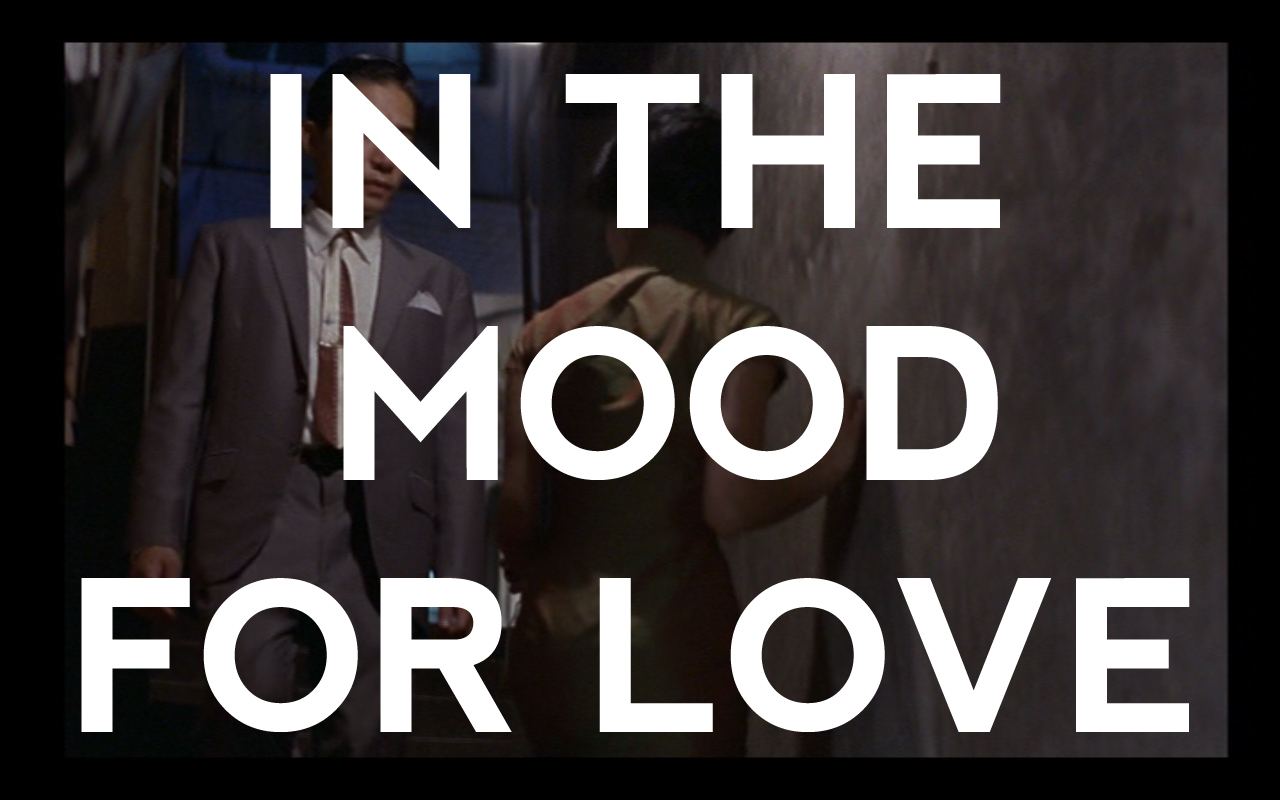
Three Reasons // In The Mood For Love

Directed by Wong Kar-Wai


Food represents so much in the film. The pair pass by each other on the way to the noodle stand - they go there when their adulterous spouses are away, when they want a lonely meal for themselves. Sesame syrup becomes a representation of romantic generosity. A touch of mustard evokes husbandly tenderness and care. When the two are eating together, it is when they are the most intimate since they never physically or sexually act on their obvious attraction for one another. 


The characters are so well-dressed and put together. There's not a hair out of place - they look like they belong in an episode of Mad Men. But their perfect outward appearance seem to magnify their inward emptiness and make their tragic circumstance seem more melancholic. 


Usually in films exploring adultery, the focus is on the adulterers. Not in this film. The camera refuses to even capture their faces and in instances when they do enter the frame, it is very brief. Wong Kar-Wai makes it clear that this is not their story.

What are your reasons?


This is a repost from my previous blog, FILM MUSIC ART